The science of moissanite.
A gemstone first discovered in a meteorite, now grown to optical perfection. Here is exactly what it is, why it behaves the way it does, and how to judge one — no marketing, just material science.
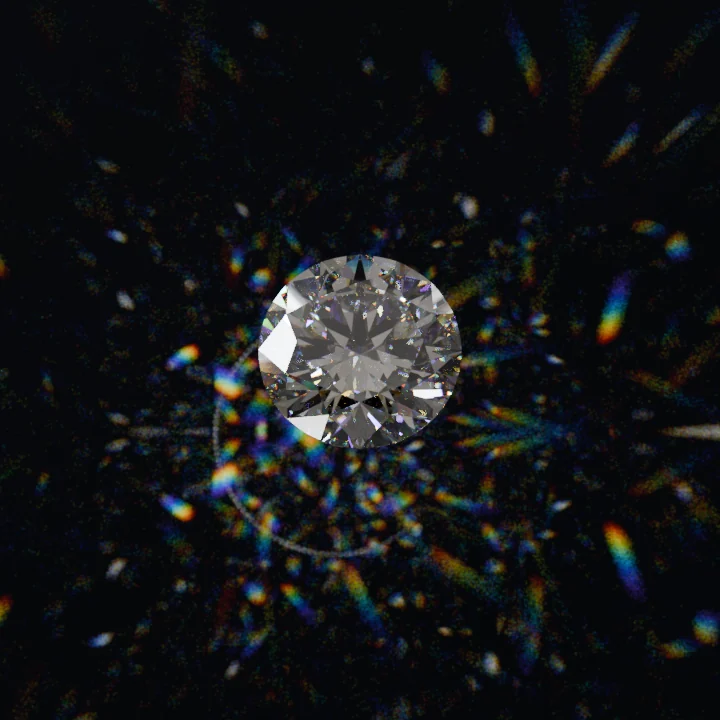
Start with the light. Drag it across the stone and watch white light bend, bounce off the pavilion and fan out into colour as it leaves — that fan is fire. The window shows the real stone under the same lamp, and the fire it throws across the table. Switch to diamond and the fire narrows in both.
- Fire
- 2.6°
- Returned
- 81%
- Lost
- 18%
← Drag the light · +12° →
| Property | Moissanite | Diamond | Sapphire |
|---|---|---|---|
| Composition | SiC | C | Al₂O₃ |
| Refractive index | 2.65–2.69 | 2.42 | 1.76 |
| Dispersion (fire) | 0.104 | 0.044 | 0.018 |
| Hardness (Mohs) | 9.25–9.5 | 10 | 9 |
| Brilliance | 20.4% | 17.2% | 7.7% |
| Toughness | Excellent | Good (cleaves) | Excellent |
| Origin | Lab-grown | Mined / lab | Mined / lab |
01 · Origin
Found in a crater, not a mine
In 1893, the French chemist Henri Moissan — later a Nobel Laureate — was examining rock samples from the Canyon Diablo meteor crater in Arizona when he found microscopic crystals he initially mistook for diamond. They were something rarer: naturally occurring silicon carbide, a mineral forged in the carbon-rich atmospheres of dying stars.
Natural moissanite is so scarce on Earth that no deposit has ever yielded a cuttable gemstone. Every moissanite gem in existence is grown — which is precisely why it is the most ethically unambiguous stone you can buy.
02 · Optics
Why it comes alive in light
Brilliance is governed by refractive index — how strongly a material bends light. Moissanite's is 2.65–2.69. Light entering the crystal travels slower, bends harder, and escapes through the crown more often, returning more white light to your eye.
Fire — the flashes of colour — is governed by dispersion: how much a material splits white light into its spectrum. Moissanite's dispersion is 0.104. That is enough to throw colour across a room, and it is the whole reason the stone seems to move when you do.
Moissanite is also birefringent (doubly refractive), which is why well-cut stones are oriented along the optic axis during cutting — a detail our graders check on every stone.
03 · Durability
Engineered for a lifetime
The Mohs scale is logarithmic. At 9.25–9.5, moissanite is harder than sapphire and ruby (9), and second only to diamond (10) among gem materials. It will not scratch in daily wear, and unlike diamond it has no cleavage planes — there is no 'wrong angle' that can split it.
Silicon carbide is also extraordinarily thermally stable. A jeweller can work on a moissanite setting with a torch without removing the stone — it tolerates over 1,100°C. This is why we back every stone with a lifetime warranty.
04 · Growth
How a gem is grown
Gem-grade silicon carbide is grown by thermal sublimation: SiC powder is heated past 2,000°C in an argon atmosphere until it vaporises and recrystallises, atom by atom, onto a seed crystal. Growing a single boule takes weeks, and only a fraction of each boule meets gem-grade colour and clarity standards.
The rough is then oriented, sawn and faceted to diamond-industry proportions. Stones are graded on the same D-to-Z colour scale used for diamonds: we sell only DEF, the fully colourless top of that scale.