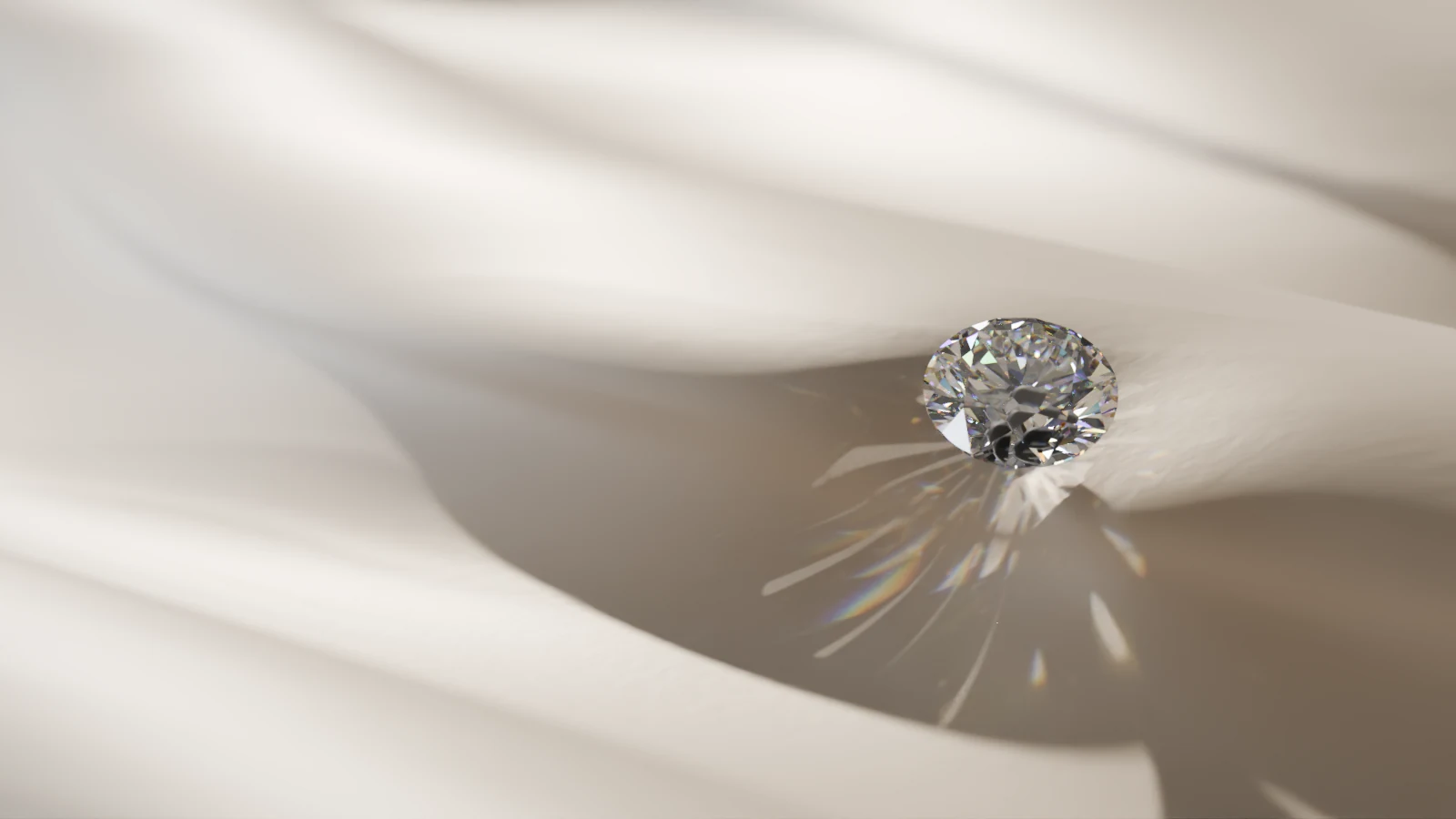
Every gemstone is a way of handling light. A stone has no glow of its own: everything you see in it is light that came in from the room, was bent, bounced and split inside, and came back out towards your eye. Moissanite is unusually good at all three, and once you know how it works, you can see it working.
The three kinds of sparkle
Jewellers describe a stone's sparkle in three parts.
- Brilliance is the white light a stone returns to you. It comes from how strongly the material bends light.
- Fire is the flashes of colour, from the stone splitting white light into its spectrum.
- Scintillation is the flicker of light and dark as the stone, the light or you move. It comes mostly from the cut.
Brilliance: bending light back to you
When light passes from air into a gem it slows down and bends. How much it bends is the refractive index. Moissanite's is 2.65–2.69, among the highest of any gemstone; diamond's is 2.42, and glass about 1.5.
A high refractive index does something useful inside the stone. Light striking a back facet at more than a certain angle can't escape, so it reflects back up instead. For moissanite that angle is about 22°, a little lower than diamond's 24°, so more of the light that enters is trapped, bounced around the pavilion and sent back out through the top. That returned light is brilliance.
Fire: splitting light into colour
White light is every colour at once, and each colour bends by a slightly different amount. A prism uses this to fan sunlight into a rainbow. The strength of the effect is called dispersion.
Moissanite's dispersion is 0.104, more than twice diamond's 0.044 and higher than almost any other gem. Inside a faceted moissanite, white light is fanned into colours that leave through different facets, so you see separate flashes of red, orange, blue and green. That is moissanite's fire, and it is the trait people notice first. Our science page shows it with real light.
| Stone | Refractive index (brilliance) | Dispersion (fire) |
|---|---|---|
| Moissanite | 2.65–2.69 | 0.104 |
| Diamond | 2.42 | 0.044 |
| Cubic zirconia | 2.15–2.18 | 0.058–0.066 |
| Sapphire | 1.76–1.77 | 0.018 |
Scintillation: the cut sets it in motion
Brilliance and fire come from the material; scintillation comes from the cutter. Each facet is a small mirror, and as the stone moves they switch on and off, which is what makes a stone seem alive rather than lit. Facet angles have to be cut for moissanite's own refractive index, not copied from diamond. A stone cut to the wrong angles leaks light through its back and looks glassy, however good the material.
Moissanite is also doubly refractive: light entering it splits into two rays. Cutters orient the stone so that, face-up, you look straight down the axis where the two rays agree, so the sparkle stays crisp. From the side, under a loupe, you may see the facet edges doubled.
Why the light around you changes everything
A stone can only return the light it receives, so where you see it matters as much as what it is.
- Sunlight and point lights (spotlights, candles, a single bulb) arrive from one direction and show fire best. This is where moissanite throws its strongest colour, sometimes onto the wall.
- Soft, even light (an overcast day, an office ceiling) arrives from everywhere and shows brilliance more than fire. The stone looks bright and white, with less colour.
- Candlelight and warm evening light are where moissanite feels most alive: a small, moving flame makes every facet flicker.
Size and cut change the rainbow
Fire grows with size. In a larger stone, light travels further before it leaves, so the colours fan out more and the flashes are larger. A 0.5 ct moissanite shows fine, sparkly pinpoints of colour; a 2 ct stone throws broad flashes you can see across a table.
Cut style matters too. Brilliant cuts such as the round, oval and cushion break light into many small, lively flashes. Step cuts such as the emerald and asscher show broader, slower flashes, like light on still water.
Is moissanite too sparkly?
Some people find a large moissanite in full sunlight a lot of rainbow, and that extra colour is how a trained eye can tell it from diamond. If you prefer a quieter stone, choose a smaller size or a step cut, which show more white and less colour. If the fire is what drew you to moissanite, go bigger and choose a brilliant cut.
One thing that dulls any stone is a film of skin oil, soap or hand cream on its back facets: it stops light reflecting inside. If a moissanite stops sparkling, it needs cleaning, not replacing; it doesn't cloud or fade with age.
See it for yourself
Every stone we sell is DEF colourless and VVS clarity, so nothing inside it gets in the light's way. You can see each one at true size on our stones page, or read how it compares in moissanite vs diamond.
Why does moissanite sparkle more than diamond?+
Moissanite has a higher refractive index than diamond (2.65–2.69 against 2.42), so it returns more light, and more than twice the dispersion (0.104 against 0.044), so it splits light into more colour.
Why does moissanite show rainbows?+
Its high dispersion splits white light into its colours, which leave the stone through different facets as flashes of red, orange, blue and green. The effect is strongest in sunlight and in larger stones.
Does moissanite sparkle in the dark?+
No gemstone makes its own light. In dim light moissanite still catches any point of light, such as a candle or a phone screen, and returns it as sparkle.
Does moissanite lose its sparkle over time?+
No. Moissanite is 9.25 on the Mohs scale and doesn't cloud or fade. If it looks dull, a film of oil or soap is blocking the light; cleaning brings the sparkle back.
Which moissanite cut sparkles the most?+
Brilliant cuts, especially the round, return the most sparkle and fire. Step cuts such as the emerald and asscher show broader, calmer flashes.