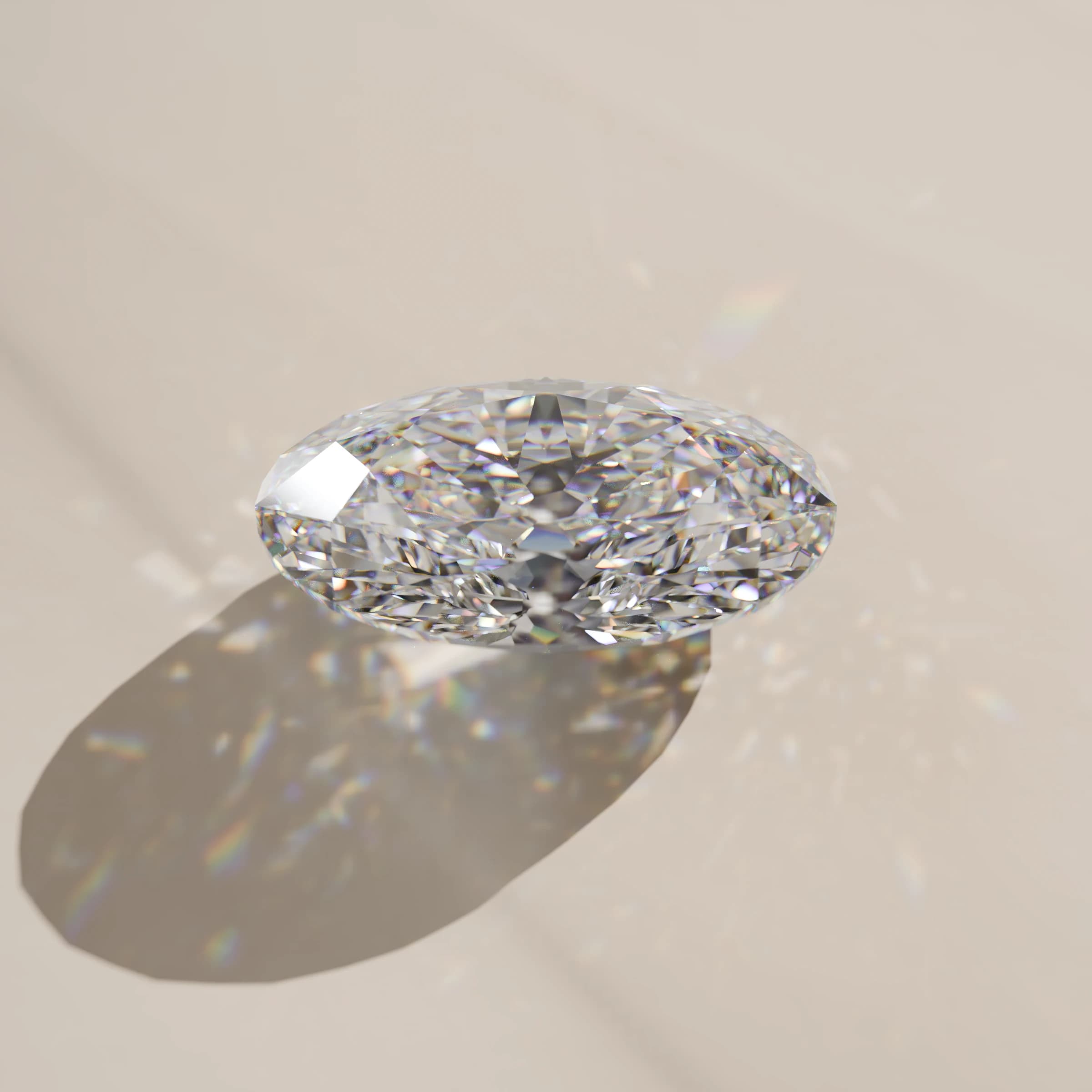
Moissanite borrows the grading language of diamond because it is the language people already know. The letters and abbreviations mean much the same thing, but a grown moissanite behaves differently from a mined diamond in a few ways that matter when you buy. This guide takes each grade in turn and says what to look for.
Are there different grades of moissanite?
Yes. Moissanite is sold across a range of colour and clarity grades, and the cut varies in quality from maker to maker. Two stones of the same size can look quite different: one icy white and full of fire, the other warm and a little glassy. The grade is what tells you which you are getting before you see it.
Colour
Colour is graded on the letter scale. D, E and F are colourless. G, H and I are near-colourless, with a faint warmth that shows most in larger stones and in white metal. J, K and below have a visible tint. Colour is the grade you are most likely to notice on a hand, so it is the one worth paying attention to. Our moissanite colour chart sets out each band and where it shows.
Clarity
Clarity describes inclusions: tiny marks inside the stone left as the crystal grew. Moissanite uses the same clarity scale as diamond.
| Grade | Meaning | What you see |
|---|---|---|
| FL / IF | Flawless / internally flawless | No inclusions found under a grader's loupe |
| VVS1, VVS2 | Very, very slightly included | Inclusions very hard to find even under magnification; clean to the eye |
| VS1, VS2 | Very slightly included | Minor inclusions visible under magnification; normally clean to the eye |
| SI | Slightly included | Inclusions easy to see under magnification; sometimes visible to the eye |
Grown moissanite is typically very clean, so most stones on sale sit towards the top of this scale. That makes clarity less of a worry than it is with diamond, but it is still worth checking. We sell VVS clarity only: nothing to see without magnification, and very little with it.
Cut
Cut is the grade that decides how a moissanite looks. Moissanite bends light more strongly than diamond and splits it into more colour, so its fire depends on precise faceting. A well-cut stone throws bright flashes of colour; a quickly cut one looks flat by comparison, whatever its colour and clarity grades say.
Moissanite is also doubly refractive. Under a loupe, some stones show a slight doubling of the back facets. Good cutters orient the stone to keep this to a minimum, and it is invisible to the eye. Our science page explains why moissanite handles light the way it does.
Cut also means shape. We cut ten: round, oval, cushion, pear, marquise, princess, asscher, radiant, emerald and heart. The shape doesn't change a stone's grade or its price.
Carat, and why moissanite uses DEW
Moissanite is a little lighter than diamond, so a moissanite and a diamond of the same size don't weigh the same. To keep sizes comparable, moissanite is described in DEW, diamond-equivalent weight: the weight a diamond of that size would have. A 1 ct DEW moissanite looks the same size as a 1 ct diamond. The millimetre size is the more exact measure, and every stone we sell lists both.
The 5 Cs of moissanite
You will sometimes see moissanite described by five Cs rather than four. The first four are the ones above: colour, clarity, cut and carat. The fifth is usually given as confidence: knowing the stone is what the seller says it is, and that it will stay that way. In practice, that comes down to two things:
- A certificate of authenticity that confirms the stone is genuine moissanite.
- A warranty that stands behind the stone for life.
Moissanite is stable: it does not cloud, fade or change colour. A lifetime warranty on it is a promise that costs a good seller little to keep, so be wary of one that won't offer it.
Certificates
Every stone we sell comes with a certificate of authenticity. It confirms the stone is genuine moissanite. Keep it with the stone: it is a record of what you bought, and useful if you later have the stone set, valued or insured. A moissanite tester, which a jeweller can use in seconds, will also confirm the stone is moissanite; a thermal diamond tester alone can read moissanite as diamond.
What is the best grade of moissanite?
For a white stone, the best grade is DEF colour with VVS clarity or better, cut precisely. That is the grade we sell, and the only one: every stone is DEF colourless and VVS clarity, with a certificate of authenticity and a lifetime warranty. Our buyer's guide walks through choosing the cut and size, and you can browse every stone at true size.
What is the best grade of moissanite?+
DEF colour (colourless) with VVS clarity or better, cut precisely. It looks white in any metal and is clean to the eye. It is the only grade Moissanite SA sells.
Are there different grades of moissanite?+
Yes. Moissanite is graded for colour (D to K and below), clarity (FL/IF, VVS, VS, SI) and size in carats (DEW), and cut quality varies between makers.
What does VVS moissanite mean?+
VVS means very, very slightly included: any inclusions are very hard to find even under magnification, and the stone is clean to the eye. VVS1 is slightly cleaner than VVS2.
What are the 5 Cs of moissanite?+
Colour, clarity, cut and carat, as for diamond, plus confidence: a certificate of authenticity and a warranty that stand behind the stone.
Does moissanite come with a certificate?+
Every Moissanite SA stone comes with a certificate of authenticity confirming it is genuine moissanite, along with a lifetime warranty.
What does DEW mean for moissanite?+
DEW is diamond-equivalent weight: the weight a diamond of the same size would have. Moissanite is a little lighter than diamond, so DEW is how its size is compared.