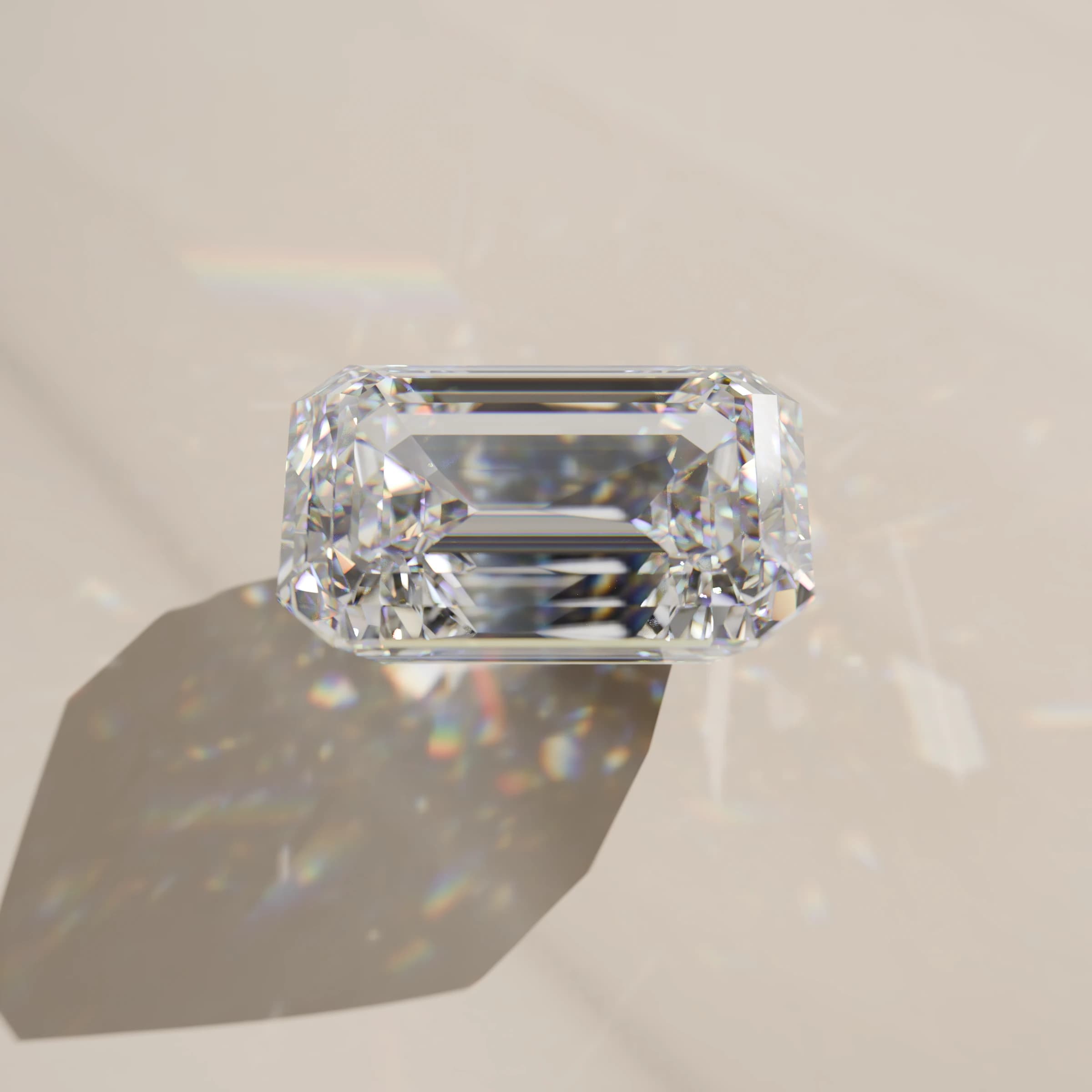
From across a room, a new cubic zirconia (CZ) and a moissanite can look alike: both are white, both sparkle. Up close and over time they behave very differently, and the price difference reflects that. Here is what each stone is, how to tell them apart, and which suits what.
What each stone is
Moissanite is silicon carbide. It was first found in a meteorite in 1893 and is now grown as single crystals over weeks, then cut like any fine gem. What is moissanite? covers it in full.
Cubic zirconia is zirconium dioxide, grown quickly and in bulk since the 1970s. It doesn't occur as a gem in nature. It was made to imitate diamond cheaply, and it does that well for costume jewellery.
Side by side
| Moissanite | Cubic zirconia | |
|---|---|---|
| Material | Silicon carbide | Zirconium dioxide |
| Hardness (Mohs) | 9.25 | 8–8.5 |
| Refractive index (brilliance) | 2.65–2.69 | 2.15–2.18 |
| Dispersion (fire) | 0.104 | 0.058–0.066 |
| Weight for its size | Light (specific gravity 3.21) | Heavy (5.6–6.0), about 80% heavier |
| On a thermal diamond tester | Usually reads as diamond | Fails |
| After years of wear | Looks as it did | Scratched, rounded edges, dull |
Durability: the difference that matters most
Ordinary dust contains quartz, which is 7 on the Mohs scale. Anything softer than about 8 gets scratched by it over time, and CZ sits only just above that line. Worn daily, a CZ picks up fine scratches and its facet edges wear round, so the sharp sparkle fades into a soft, slightly milky look. That's why CZ is usually treated as a stone you replace.
Moissanite, at 9.25, is harder than everything except diamond in daily life, and it has no cleavage planes, so it resists chipping. It keeps its polish and its edges. Ours carries a lifetime warranty for that reason.
How they look
Moissanite bends light more strongly than CZ, so a well-cut stone returns more bright, white sparkle. It also splits light into colour almost twice as much, which gives it its rainbow flashes. CZ looks lively when new, but softer and glassier beside a moissanite. We explain the optics in why moissanite sparkles.
Colour differs too. Most CZ is made perfectly colourless. Moissanite is graded on the D-to-K scale, and cheaper moissanite can show a faint warmth. We sell only DEF colourless; the colour chart shows what each grade looks like.
How to tell moissanite from CZ
- A diamond tester. Moissanite usually beeps as diamond on a thermal tester; CZ fails. See does moissanite pass a diamond tester?
- Weight. On a carat scale, a CZ weighs far more than a moissanite of the same size.
- Wear. Under a loupe, a worn CZ shows scratches on the table and rounded facet junctions.
- Doubling. Looking through a moissanite at an angle under a loupe, you see the back facet edges doubled. CZ is singly refractive and shows no doubling.
Is moissanite fake?
No. Moissanite is a real mineral, and a grown moissanite is real silicon carbide, in the same way that a lab-grown diamond is real diamond. It only becomes “fake” if someone sells it as something it isn't, such as diamond.
The term people usually mean is simulant: a stone worn in place of diamond. In that sense moissanite and CZ are both diamond simulants. The difference is that moissanite is a fine gemstone with its own properties, made to last a lifetime, and CZ is a low-cost imitation.
The real risk runs the other way: cheap stones sold online as “moissanite” that are actually CZ or glass. If the price seems too good, ask for a certificate and have it tested. Where to buy loose moissanite covers what to check before you buy.
Price
CZ costs very little: a loose stone can sell for the price of a coffee. Moissanite costs more because growing and cutting it takes far longer. Our stones start at R 1 600, and the price guide lists every size.
Which should you choose?
For costume jewellery, a travel ring or something you'll wear a few times, CZ is a sensible, inexpensive choice. For an engagement ring, or anything you mean to wear every day for years, moissanite is the one that will still look right in ten years.
Every moissanite we sell is DEF colourless and VVS clarity, with a certificate of authenticity and a lifetime warranty. Browse the stones at true size.
What is the difference between moissanite and cubic zirconia?+
Moissanite is silicon carbide, 9.25 on the Mohs scale, with more brilliance and fire. Cubic zirconia is zirconium dioxide, 8–8.5 on the Mohs scale, much cheaper, and it scratches and dulls with daily wear.
Is moissanite better than cubic zirconia?+
For jewellery worn every day, yes. Moissanite is harder, sparkles more and keeps its polish for life. Cubic zirconia is fine for costume jewellery but wears visibly within a few years.
Is moissanite fake?+
No. Moissanite is a real mineral, silicon carbide. Gem moissanite is grown in a lab, as lab-grown diamond is, but it is real moissanite. It would only be fake if it were sold as diamond.
Does moissanite get cloudy like cubic zirconia?+
No. Cubic zirconia looks cloudy over time because its surface scratches and wears. Moissanite is hard enough not to, and it doesn't change colour. A moissanite that looks cloudy just needs cleaning.
How can I tell if my moissanite is really cubic zirconia?+
Put it on a thermal diamond tester: moissanite usually reads as diamond, while cubic zirconia fails. Cubic zirconia is also much heavier for its size and shows no doubled facet edges under a loupe.