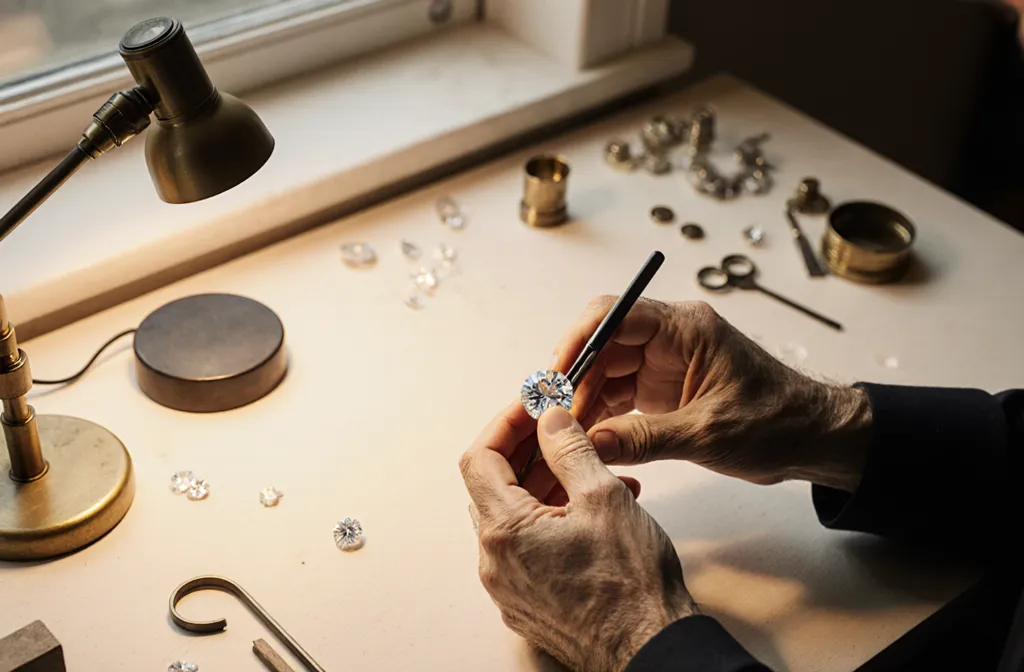
More South African jewellers are setting moissanite for customers who want a large, white stone without a diamond's price. It's an easy stone to work with, and most of what you already do applies. This guide covers the points where it differs. Trade accounts get our full bench guide in the portal.
What you're working with
| Material | Silicon carbide (SiC), lab-grown |
| Hardness | 9.25 on the Mohs scale; only diamond is harder |
| Toughness | Excellent, with no cleavage planes, but edges and points can chip under direct pressure |
| Refractive index | 2.65–2.69, doubly refractive |
| Heat | Stable through normal torch work; turns yellow or brown while hot, and the colour returns as it cools |
| Testing | Reads as diamond on a thermal tester; a multi-tester identifies it |
Because it reads as diamond on a thermal tester, check what you're given before you quote on a repair. See does moissanite pass a diamond tester?
Seats and bearings
Most chips come from a poor seat, not a hard knock. The stone should sit level, with its girdle fully supported and its pavilion resting evenly in the bearing.
- Cut the bearing to the stone's pavilion angle. A gap between the bearing and the girdle means the stone is resting on an edge and will lever when you close the metal.
- Check pre-cut bearings in castings: they're often the wrong angle for the stone you're setting.
- Keep girdles apart from each other and from the metal; contact chips under setting pressure.
Points and corners
Princess, marquise, pear, heart and radiant cuts have points that need protecting. Relieve the seat at each point so it sits in a pocket and carries no pressure, use V-prongs or corner claws that cover the point, and push metal onto the crown facets beside the point, never onto the tip.
Prongs, bezels and pavé
- Prongs. Bring the metal down over the crown and seat it firmly; don't drive it into the girdle edge.
- Bezels. Keep the bearing level and free of burrs, and burnish over the crown in small steps, working opposite sides.
- Pavé and bead setting. Set the girdle just below the metal surface, raise the beads over the crown, and keep the beading tool off the stone.
Heat, soldering and repairs
You can size rings, re-tip prongs and solder near a set moissanite without removing it, and laser welding is safe. Three habits avoid nearly every problem:
- Clean first. Oil and dirt left on the stone can burn onto its surface under the torch, so steam or ultrasonic the piece before you heat it.
- Don't panic at the colour. The stone turns yellow or brown while hot and returns to colourless as it cools.
- Cool in air. Don't quench a hot piece in water or pickle; the sudden change in temperature risks cracking the stone.
A hazy or oil-slick look after heating is surface residue, not damage. Clean the stone again, and call us if it won't shift.
Cleaning and polishing
Ultrasonics and steamers are safe. Keep silicon carbide abrasives (sanding discs, drums and SiC wheels) away from the stone: they're the same material and will scratch it. Take care with diamond compounds near the facets, and avoid tumbling or magnetic finishing with stones set. Rhodium plating with the stone in place is fine at normal bath temperatures, once the piece is clean and degreased.
Orientation and double refraction
Moissanite is doubly refractive. A well-cut stone is oriented so you look down its optic axis through the table and see no doubling face-up, but you may see doubled facet edges from the side. That's normal, not a fault. It's also why a well-cut moissanite stays crisp: our guide to why moissanite sparkles explains the optics for customers who ask.
Buying moissanite for the trade
Moissanite SA has supplied South African jewellers since 1999. Our SOLA™ range is DEF colourless and VVS clarity in ten cuts, with stones of 5mm and larger laser-inscribed and certified, and a lifetime warranty that passes to your customer when you set and sell the stone. Sizes are listed in our size chart.
A trade account gives you trade pricing, a wholesale portal and the full bench guide. Damage during setting or repair isn't covered by the warranty, so if a job is new to you, call us on 010 100 8760 first.
Can you solder near a moissanite?+
Yes. Moissanite is stable through normal torch work, so you can size, re-tip and solder with it set. Clean the piece first, expect the stone to turn yellow or brown while hot, and let it cool in air rather than quenching it.
Why did my moissanite change colour when I heated it?+
Moissanite turns yellow or brown while hot and returns to colourless as it cools. A haze left afterwards is burnt-on residue from oil or dirt, not damage; clean the stone again.
Is moissanite hard to set?+
No. It sets like any hard, faceted stone. Cut the bearing to its pavilion angle so the girdle is evenly supported, and protect points and corners with V-prongs or corner claws.
Where can South African jewellers buy moissanite wholesale?+
Moissanite SA has supplied South African jewellers since 1999. A trade account gives trade pricing on the SOLA™ range, DEF colourless and VVS clarity, with a lifetime warranty that passes to the jeweller's customer.