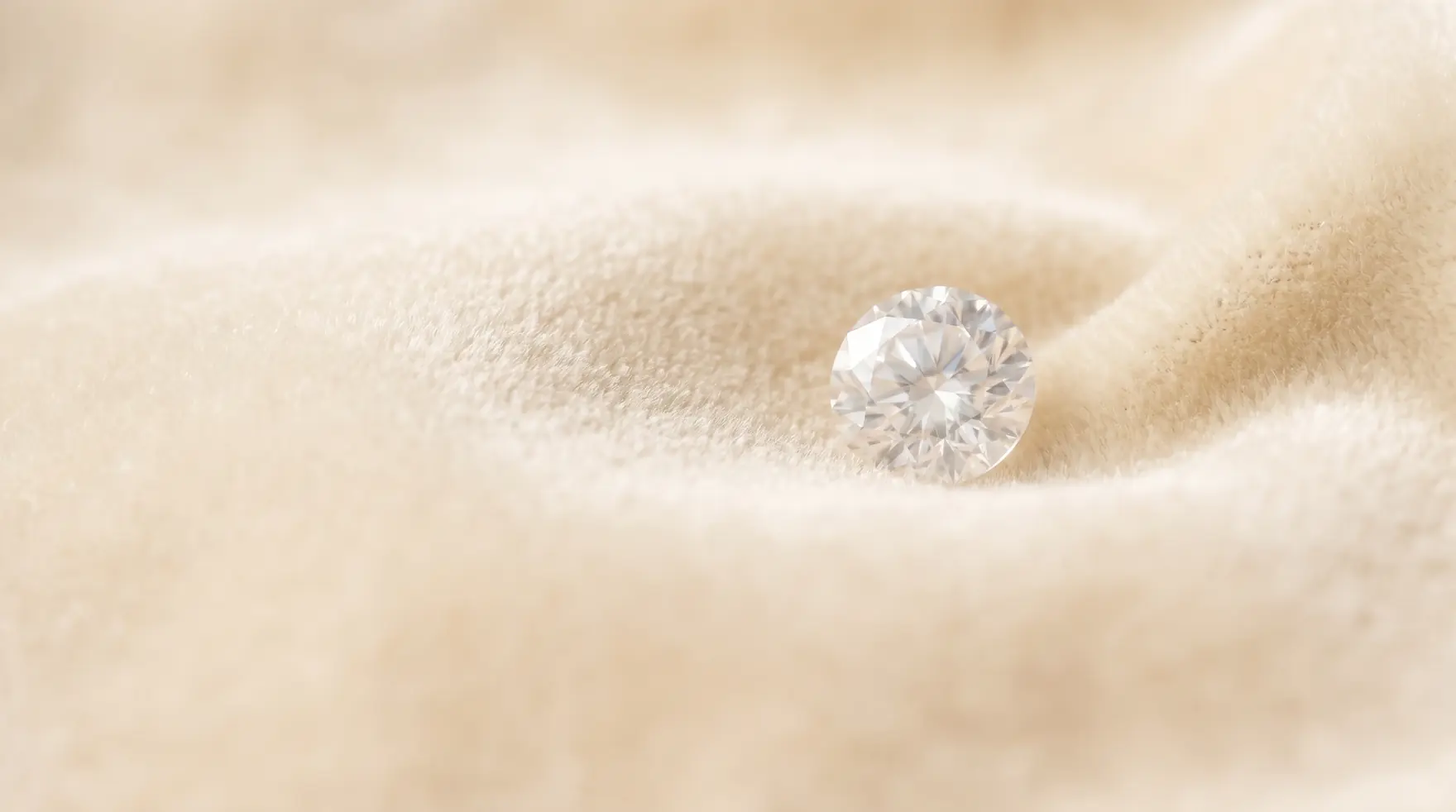
Moissanite has an unusual history for a gemstone. It was identified as a mineral more than a century before anyone could wear it, because nature never made it in pieces large enough to cut. The stone you can buy today exists because of a chemist's curiosity in the 1890s and a crystal-growing breakthrough a hundred years later.
1893: a discovery in a meteorite
Henri Moissan was a French chemist. In 1893 he was examining fragments of the Canyon Diablo meteorite, which had struck the Arizona desert, when he found small, very hard, glittering crystals among them.
He first thought they were diamond. That was a reasonable guess — the crystals were hard and bright, and diamond was the obvious candidate. Further study showed they were something else: silicon carbide, a compound of silicon and carbon.
Where does moissanite come from?
The first moissanite ever identified came from a meteorite, which is where the idea of moissanite as a stone “from space” comes from. Natural moissanite is extremely rare, and it occurs only as tiny grains. None of it is large enough to cut into a gem.
So while the story begins with a meteorite, the moissanite in jewellery does not come from space. Every moissanite gemstone is grown in a lab, from the same material Moissan identified.
1905: the mineral is named
In 1905 the natural mineral was named moissanite in Moissan's honour. The following year, 1906, he won the Nobel Prize in Chemistry — not for moissanite, but for isolating the element fluorine.
A century as a curiosity
For most of the twentieth century, moissanite stayed a mineral of scientific interest rather than a gem. The problem was size. Nature only made it in tiny grains, and no one could yet grow it as large, clear single crystals — which is exactly what a gemstone needs: one clean crystal big enough to cut into facets.
The 1990s: growing a gem
That changed in the 1990s, when a process to grow large single crystals of silicon carbide was developed. For the first time, a crystal could be grown big and clear enough to be cut and polished into a gemstone.
The results had properties no one had seen in a jewellery stone before: a refractive index of 2.65–2.69 (diamond's is 2.42), dispersion of 0.104 — more than twice diamond's fire — and a hardness of 9.25 on the Mohs scale, just below diamond's 10.
1998: moissanite goes on sale
Moissanite gemstones first went on sale in 1998. That is when moissanite became something you could buy and wear, rather than a mineral in a textbook. A year later, in 1999, we began selling moissanite in South Africa.
Moissanite today
More than twenty-five years on, moissanite is chosen on its own merits: more fire than diamond, top colour and clarity grades at a fraction of a diamond's price, and a hardness that stands up to daily wear. It is stable, too — it doesn't cloud, fade or change colour.
Cutting has become more exact as well. Moissanite's fire depends on precise faceting, and because the stone is doubly refractive, good cutters orient each stone to minimise the facet doubling that can show under a loupe. Today it is cut in every classic shape; we offer ten, from round and oval to emerald and heart.
We sell only DEF colourless, VVS clarity stones, from 0.5 ct to 4.5 ct DEW (diamond-equivalent weight, the familiar way of describing a stone's size). Every stone comes with a certificate of authenticity and a lifetime warranty.
Timeline
| Year | Event |
|---|---|
| 1893 | Henri Moissan finds silicon carbide crystals in fragments of the Canyon Diablo meteorite, Arizona |
| 1905 | The mineral is named moissanite in his honour |
| 1906 | Moissan wins the Nobel Prize in Chemistry, for isolating fluorine |
| 1990s | A process to grow large single crystals of silicon carbide is developed |
| 1998 | Moissanite gemstones go on sale |
| 1999 | Moissanite SA begins selling moissanite in South Africa |
Read on
For what moissanite is and how it looks and wears, see what is moissanite? For the material itself, see our science page, and for how it compares with diamond, moissanite vs diamond. More about us is on the about page.
Who discovered moissanite?+
Henri Moissan, a French chemist, in 1893. He found the crystals in fragments of the Canyon Diablo meteorite in Arizona, first took them for diamond, then identified them as silicon carbide.
Where does moissanite come from?+
The first moissanite was found in a meteorite, but natural moissanite is extremely rare and occurs only as tiny grains. Every moissanite gemstone is grown in a lab.
Is moissanite from space?+
The first crystals were found in a meteorite, which is where the idea comes from. The moissanite sold as gemstones is grown in a lab; it does not come from space.
When did moissanite become popular?+
Moissanite gemstones went on sale in 1998, after a way to grow large single crystals was developed in the 1990s. Moissanite SA has sold it in South Africa since 1999.
Why is it called moissanite?+
It was named in 1905 in honour of Henri Moissan, who discovered it in 1893. He won the Nobel Prize in Chemistry in 1906 for isolating fluorine.